
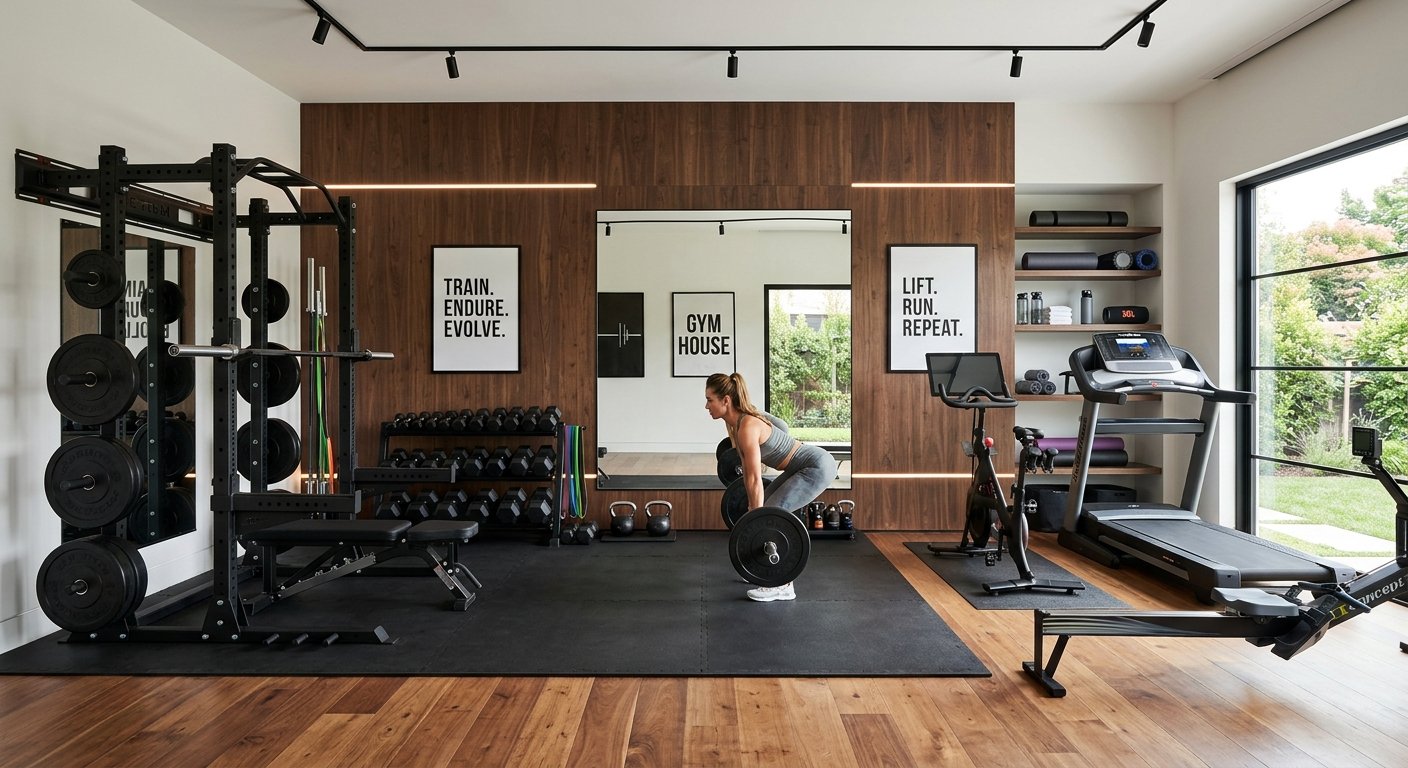
Walk into most home gyms and you’ll see the same thing: a rack, a rubber floor, maybe a motivational poster that came free with a protein powder order. It works, technically. But a space that looks half-finished doesn’t pull you downstairs at 6 a.m., and it definitely doesn’t make you want to linger for that extra set of accessory work. The way a training space looks and feels has a real effect on whether you use it consistently, so it’s worth treating the decor as part of the equipment list, not an afterthought.
This guide walks through how to actually design a gym space — home or commercial — that looks intentional, holds up to sweat and steel, and reflects the kind of training you do there.
Why Gym Decor Actually Matters
A gym is a sensory environment before it’s anything else. Lighting affects alertness and mood. Color affects perceived energy. Clutter raises stress hormones almost as reliably as it raises your risk of stubbing a toe on a stray kettlebell. Commercial gym chains spend real money on branding, lighting design, and wall graphics for a reason — the environment shapes how hard people train and how long they stay members.
For a home gym, the stakes are a little different but no less real. A garage that still looks like a garage, with cardboard boxes stacked next to the squat rack, doesn’t feel like “gym time” when you walk in — it feels like chores. A space with a defined identity, even a small one, signals to your brain that you’ve entered a different mode.
Start With Function, Then Layer in Style
Before picking colors or artwork, map out how the space is actually used. Decor decisions should never compromise safety or movement.
- Clearances first. Leave enough room for barbell paths, kettlebell swings, and lunges without anything on the wall or floor creating a hazard.
- Flooring as a design element. Rubber gym tiles, turf strips, or interlocking mats aren’t just protective — they’re one of the biggest visual anchors in the room. Black tiles read as classic and gritty; a two-tone layout (like a turf lane bordered by black rubber) adds structure without extra cost.
- Zoning. Even a single-car garage gym benefits from loosely defined zones — a lifting area, a cardio corner, a mobility mat space. Decor cues (a rug, a different paint accent, a mirror placement) can mark these zones without walls.
Once the layout is locked in, decor becomes about reinforcing that function, not fighting it.
Wall Treatments That Hold Up
Gym walls take abuse — chalk dust, humidity, the occasional dropped plate — so finishes matter as much as aesthetics.
Paint and Color Psychology
Darker, moodier palettes (charcoal, matte black, deep navy) are popular in strength-focused spaces because they read as serious and industrial, and they hide scuffs well. Brighter spaces — white, light gray, soft green — tend to suit yoga, mobility, or cardio-focused rooms, since lighter tones feel more open and calming. Accent walls in a single bold color (rust orange, deep red, forest green) behind a rack or mirror give the room a focal point without overwhelming it.
Textured and Industrial Finishes
Exposed brick, board-formed concrete panels, or corrugated metal sheeting are common in boutique studios because they read as raw and purpose-built. For a home setup, peel-and-stick brick or concrete-look wallpaper gets a similar effect at a fraction of the cost and effort.
Wall Graphics and Vinyl Decals
Large-format vinyl — a favorite in CrossFit boxes and boutique studios — is one of the most cost-effective ways to add personality:
- Motivational typography (short phrases, not paragraphs — they lose impact fast)
- Anatomical or muscle-group line art
- Brand or gym name lettering
- City skyline or topographic map silhouettes for a sense of place
Decals are removable, which matters if you rent or plan to change the theme later.
Mirrors: More Than Just Form-Checking
Mirrors are functional first, decorative second, but they do heavy lifting on both fronts. A full wall of mirrors visually doubles a small space, which matters enormously in home gyms carved out of garages or spare rooms. Beyond the classic wall-to-wall install, a few variations are worth considering:
- Framed mirror panels instead of a single sheet, for a more finished, less “big-box gym” look
- Angled or partial mirror walls if full coverage feels too clinical
- Mirrors paired with a contrasting frame color (black metal frames against a light wall, for instance) to add a design line rather than a blank reflective surface
Whatever the layout, mirrors should be tempered, gym-rated glass — a cracked mirror near a barbell path is a real hazard, not just a bad look.
Lighting: The Most Underrated Decor Decision
Lighting changes a room’s mood more than almost any other single choice, and it’s frequently the last thing people think about.
- Layered lighting — a mix of overhead general lighting, targeted task lighting over lifting platforms, and accent lighting (LED strips along mirror edges or shelving) — creates depth that a single overhead fixture never will.
- Color temperature matters. Cooler light (5000K–6500K) feels energizing and is common in strength-training areas. Warmer light (2700K–3000K) suits recovery, stretching, or yoga corners.
- RGB and smart lighting let a single space shift moods — bright white for a heavy lifting session, dimmer warm tones for mobility work — without any physical changes to the room.
- Natural light, where available, should be preserved rather than blocked. It’s free, and it does more for morale than most purchased decor.
Storage as a Design Feature, Not an Eyesore
Cluttered equipment is the single biggest thing that makes a gym feel unfinished, regardless of how nice the walls look. Treating storage as part of the design solves two problems at once.
- Open shelving with matched storage bins for bands, straps, and small accessories keeps things visible and grabbable while still looking curated
- Wall-mounted racks for kettlebells, plates, and dumbbells (pegboard-style or slatwall) free up floor space and turn equipment into a display
- Slatwall or pegboard sections double as functional storage and a textured design element
- A dedicated foam roller and mat rack near the mobility zone keeps recovery tools from ending up in a pile
Color-coordinating bins, mats, and equipment (plates, bands, mats in a consistent palette) does more for a “designed” look than almost any wall art.
Personal Touches That Add Character
Once the functional layer is in place, the details are what make a space feel like your gym rather than a generic showroom.
- Plants. Low-maintenance varieties (snake plants, pothos, ZZ plants) tolerate inconsistent light and humidity swings better than most greenery, and they soften an otherwise hard, metal-and-rubber room.
- Personal milestones on display. A small whiteboard or chalkboard wall for tracking PRs, a framed race bib, or a shelf for competition medals gives the space a lived-in, motivating history.
- Sound. A wall-mounted Bluetooth speaker or a simple sound system, tucked into the design rather than left as a loose cord tangle, matters more to daily motivation than most visual choices combined.
- Seating or a small bench area. Even a single stool or bench near the entrance gives a place to sit for shoe changes or warm-up stretches, and it breaks up an otherwise all-equipment room.
Budget-Friendly vs. High-End Approaches
| Element | Budget-Friendly Option | Higher-End Option |
|---|---|---|
| Flooring | Interlocking foam or rubber tiles | Poured rubber flooring, custom turf inlay |
| Walls | Paint + peel-and-stick decals | Textured panels, custom vinyl murals |
| Mirrors | Single large framed mirror | Full mirrored wall, professionally installed |
| Lighting | Clip-on LED shop lights, string lights | Recessed layered lighting, smart RGB systems |
| Storage | Freestanding shelving units | Built-in wall-mounted slatwall systems |
A well-designed gym doesn’t require a large budget — it requires intentional choices at every price point, rather than defaulting to whatever’s cheapest or most convenient.
Common Mistakes to Avoid
- Overdecorating a small space. Too many wall graphics, too many colors, or too much furniture makes a small gym feel cramped rather than energizing.
- Ignoring ventilation and humidity when choosing finishes — some wallpapers and untreated wood don’t hold up well in a space that gets sweaty and occasionally chalky.
- Ceiling-mounted decor near lifting zones. Anything hanging low enough to interfere with an overhead press or a jump rope session is a hazard, not decor.
- Choosing decor before function. Picking a paint color before confirming rack placement, mirror location, and equipment clearances often leads to expensive rework.
Frequently Asked Questions
Does gym decor actually affect motivation to work out? Environment has a measurable effect on mood and energy, which in turn affects training consistency. It won’t replace discipline, but a space that feels good to walk into removes one more excuse to skip a session.
What’s the best flooring for a home gym on a budget? Interlocking rubber or foam tiles are the most cost-effective option that still protects both the floor underneath and any dropped equipment. They’re also easy to reconfigure or replace section by section.
Should I paint my gym a dark color or a light color? It depends on the room’s natural light and the type of training. Dark, moody palettes suit strength-focused spaces with good artificial lighting; lighter palettes work better in rooms with limited natural light or a focus on yoga, mobility, and recovery.
Are wall decals durable in a gym environment? Quality vinyl decals rated for humidity and temperature swings hold up well in most home gym conditions. They’re also easy to remove or replace if the space changes.
How much does it cost to decorate a home gym? Costs vary enormously depending on choices — a few hundred dollars covers paint, a mirror, and basic storage, while a fully custom build with poured flooring, professional lighting, and built-in storage can run into the thousands. The layered approach in this guide works at any budget; it’s about sequencing decisions, not spending a fixed amount.
Bringing It All Together
The gyms that people actually enjoy training in aren’t necessarily the most expensive ones — they’re the ones where every choice, from flooring to lighting to that one plant in the corner, feels deliberate. Start with function, protect the space you have with the right finishes, and then let the personal details accumulate over time. A gym that looks finished from day one is nice, but a gym that keeps evolving alongside your training is the one you’ll actually want to walk into, year after year.
